Sunday, November 29, 2020

The Piano Teacher (2001, Michael Haneke)

Quest Status: 722 / 1000

TSPDT Rank #699

I've always been meaning to get into the films of Michael Haneke, but...

No, I won't go there. Sure, I had only seen two Haneke films (The Castle and the original Funny Games) before this one. But let's put that aside. After watching The Servant, I saw The Piano Teacher in my watchlist and was irresistibly drawn to it, although I knew little about it. The little I sensed from the poster and a few scattered comments across the internet about control and sadomasochism were enough to intuit that it was the natural next step after the frustratingly vague but endlessly disturbing insinuations of The Servant.
 
 
And indeed, this is the next step. Rather than masters and servants, The Piano Teacher focuses on the power dynamics between teacher and student. In a world where most people no longer listen to classical music, the existence of those who perform it becomes  cutthroat and unforgiving. Enterprising students practice can for eight hours a day while their parents prod them to go further - and for respected professors like Erika Kohut (Isabelle Huppert), a cold and frightening virtuoso teacher, it can never be enough. But Professor Kohut has problems of her own. She lives with her mother in a tiny Vienna apartment, her every move thrown under abusive levels of scrutiny despite being in her late 40s. She seems to have little to no sexual experience, stealing away to sleazy porno shops to vicariously experience what is always out of reach to someone as inaccessible and devoid of feelings as she is, while performing acts of self-mutilation and dreaming up masochist fantasies to punish herself for her perceived sins.
 
 
Enter Walter Klemmer, an attractive young man with a predilection for Professor Kohut's favorite composer, Franz Schubert. He is instantly attracted to the older woman's outwardly controlling aura and senses the vulnerability and loneliness lying beneath her hard veneer. But little does he know how deep it lies. As Walter becomes Erika's student, Haneke probes into their volatile relationship with unflinching realism, even as the power dynamics begin to shift and the roles of teacher and student begin to come into question. Haneke's style of realism is uncomfortable to watch because it feels so plausible. Like The Servant, this film doesn't answer the difficult psychological questions that are posed to the viewer, although Haneke's calculated setup allows us to follow both character's movements with sickening clarity. At the film's conclusion, when the tension that has been building for two hours finally breaks, it's a moment that we can comprehend on a primal level even if we've never been in that particular situation before - just as a good serial killer film allows the viewer to vicariously inhabit a murderer's psyche.

--- 278 films remaining---

Sunday, November 22, 2020

The Servant (1963, Joseph Losey)

Quest Status: 721 / 1000

TSPDT Rank #540

"I've always been meaning to get into the films of [insert semi-obscure director], but..." It's starting to feel like a mantra these days, but it's true: I've always meant to get into the films of Joseph Losey, but for years the only one I've seen has been 1948's The Boy with Green Hair. Despite its jokey title, that film is actually a serious movie about discrimination which can be enjoyed by children and adults alike. For The Servant, however, leave the kids at home! They won't know what they've just seen... and you won't know what to tell them! (That would have been a good tagline for this movie, actually.) It's stunning that such an insinuating, nasty, and morally ambiguous film was able to be released in 1960s England, although I'm not surprised that it was soon swept under the rug and has been pretty hard to get ahold of every since.


The film follows the complicated relationship between an idle aristocrat, Tony (James Fox), and his slyly ambitious manservant Barrett (Dirk Bogarde). We first meet Tony through Barrett's eyes, as Barrett catches him in the midst of a drunken afternoon stupor - despite his appointment for a job interview. It's immediately apparent that Tony needs some looking after - he even says so himself - and Barrett is the man to do it. Not that Tony's girlfriend Susan agrees. She's immediately suspicious of Barrett, a suspicion that soon grows into outright aggression. But why is she so suspicious? Because Barrett is a peeping tom who always happens to be around when the two are together? She almost seems jealous of Barrett, but why should she be?


This is the question that The Servant asks, but never gives a direct answer to. In lieu of an answer, Losey only gives us more questions. Such as, why would a man with a beautiful and sophisticated girlfriend debase himself for a crass and incompetent servant girl? Why would someone take back a servant who had committed an unjustifiable offense in his bedroom? Why do some people destroy themselves for the sake of others when they could easily avoid it? Who is the master and who is the servant? Based on a homosexually suggestive novella by Robin Maugham, with a screenplay written by the class conscious Harold Pinter, this tense and disturbing Losey film fearlessly explores the class relations in British aristocracy. It's the rare film that doesn't present its intentions to the viewer on a silver platter, but forces them to open locked doors and probe into the shadows to search for what may or may not be hiding there. That The Servant concerns a power struggle between master and servant is never in question - but what exactly is at stake for both men in this struggle is one question that Losey is content to leave hidden in plain sight.

--- 279 films remaining---

Friday, November 20, 2020

Miller's Crossing (1990, Joel & Ethan Coen)

Quest Status: 720 / 1000

TSPDT Rank #718

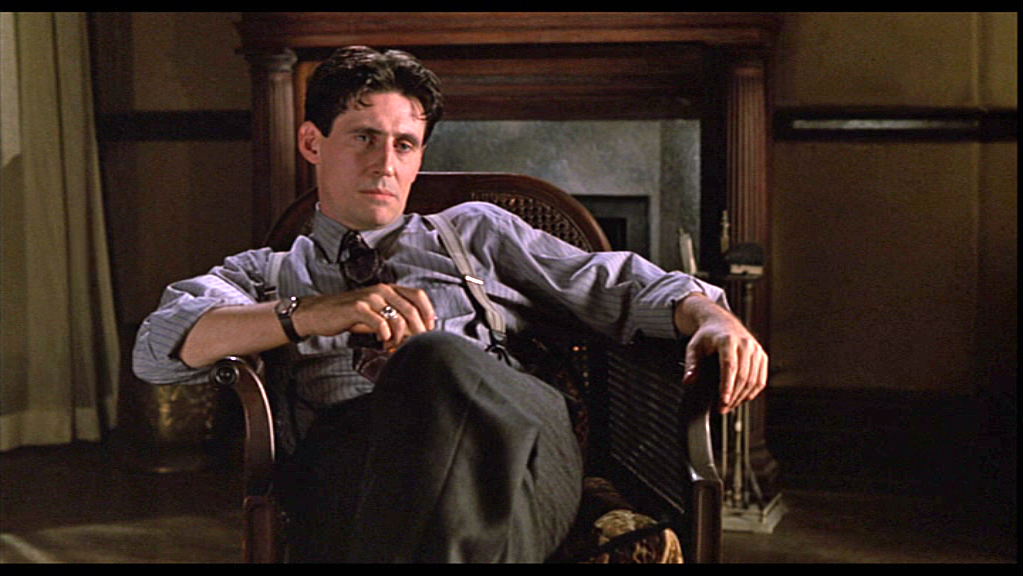
There have been a lot of movies made about the Mafia, but not too many about the Irish mob. In Miller's Crossing, the two tribes cross paths and attempt to coexist, but the Irish whiskey-drinking Tom (Gabriel Byrne) is at the center of it all. Compared to the lurid suspense of the Coen brothers' first film, Blood Simple, and the manic screwball comedy of their second, Raising Arizona, Miller's Crossing is a much more subdued film in general. Still, the Coens' signature style is all over this film - with a convoluted plot full of countless "ins and outs," obscure symbolism, and a constant undertone of irony. It also features the Coens' trademark plot device of a man caught in a downward spiral and overwhelmed by forces beyond his comprehension.

Initially, this downward spiral isn't that evident, nor are the Coens' usual trademarks in clear view from the start. This is a slow burn film, with the central conflicts of the story only coming into clear view about halfway through the film. What we do know is this: Tom is the right hand man for a political fixer and mob boss Leo O'Bannon (Albert Finney) who runs a Prohibition-era city. The city is never identified, but the Coens shot the film in New Orleans because much of its architecture dates back to this era. Tom and Leo share a strong bond which is able to withstand any argument or difference of opinion, but when the devious Verna Bernbaum (Marcia Gay Harden) comes between them, their bond threatens to collapse. It doesn't help that Verna's brother Bernie (John Turturro) has run afoul of one of Leo's underlings, an Irish mob boss with ambitions of his own.

 
The plot thickens from here. There are countless nods to film noir and Dashiell Hammett novels, although the mood is different, more solemn and detached. One scene which sets the film apart from its source material is a brutal assassination scene set at the titular wooded crossing, a gut-churning moment of fear, power and moral crisis which has more in common with Bertolucci's The Conformist than Dashiell Hammett. There's also a scene in which Albert Finney jumps down from his bedroom window and mows down assassins in a bathrobe while "Danny Boy" blares on the soundtrack, but that's pure Coen. As for the hat floating in the woods, it's anybody's guess. Much like the tumbling tumbleweeds in The Big Lebowski, the answer is blowin' in the wind.
 

--- 280 films remaining---

Saturday, November 14, 2020

DOUBLE FEATURE: Tropical Malady / Uncle Boonmee Who Can Recall His Past Lives

It's amazing to see 21st century films making it so high on the list in recent updates. For some of us who tend to be stuck in film history's past much of the time, these films show that there are plenty of recent films which will go on to take their place in the pantheon before long.


Tropical Malady (2004, Apichatpong Weerasethakul)

Quest Status: 718 / 1000

TSPDT Rank #229

Tropical Malady was my introduction to the Thai director Apichatpong Weerasethakul, whose work I've been meaning to look into for a long time. It might even be the first Thai film I've ever seen (amazingly enough). I didn't know what to expect, but my expectations were still confounded. From the bits and pieces I had heard over the years, I guess I expected it to be visually beautiful but a bit abstract and strange. I had also heard that the second half diverges sharply from the first. Other than this, I went in open to anything. The opening sequence, with a group of soldiers traversing through an open field, posing with a dead body, and flirting with a radio operator as they carry the body, set up a subtly bizarre atmosphere. This mood was only accentuated when a naked man ran through the background as a dream pop song played on the soundtrack.

As it turns out, these two threads eventually turn out to intersect, although not in a way that makes much sense. This really is a head-scratcher of a film. After the vague and seemingly random opening, the film becomes a love story between two men, a soldier named Keng (Banlop Lomnoi) and an illiterate ice factory worker named Tong (Sakda Kaewbuadee). It is never clear what draws them together. Tong doesn't seem too outwardly attractive and can barely even write his own name, but he seems to give off a charm that attracts women both young and old, as well as Keng. He also has a mysterious urge to dress up as a soldier, although he isn't one, or at least isn't at the time the story begins. This section of the film reminded me of some other meditative Asian films about loneliness, desire, and living on the outskirts of society (including one I saw recently, Taiwanese director Tsai Ming-liang's Rebels of the Neon God). However, it also has a subtly spiritual and rural feel to it, particularly in a scene where Keng and Tong venture down into a cave temple with an eccentric holy woman.


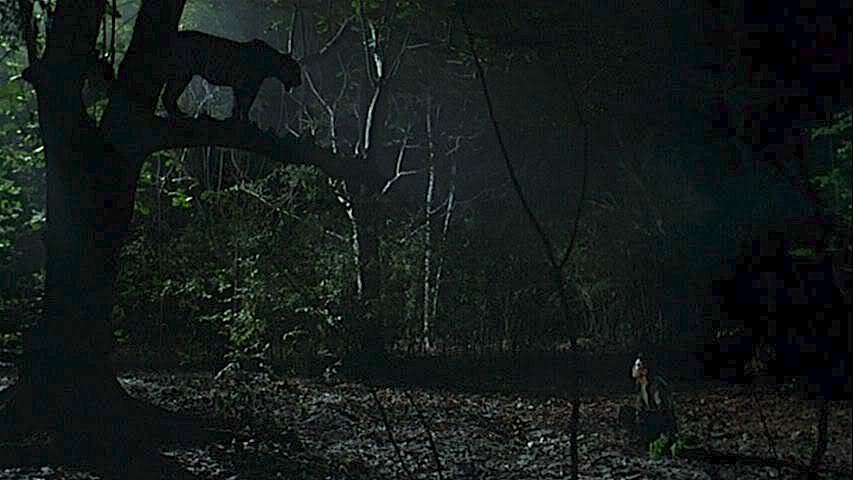
Gradually, the men's tentative passion begins to flower and come out into the open, at which point Weerasethakul abruptly shifts gears. After a strange moment in which Keng and Tong both occupy the same bedroom at separate times, a title screen appears, effectively announcing the start of a new film. Intertitles lay out a folk tale about a shaman who can turn into various animals, mainly taking the form of a tiger, in order to seduce and devour men. Keng reappears as a lone hunter, endlessly trudging through a labyrinthine forest tracking the tiger spirit (played in his human incarnation by Kaewbaudee). When taken together with the opening quotation that "all men are wild beasts" and the love story which occupies the first half of the film, this mystical segment of the film seems to imply that Tong is a beguiling spirit out to devour and become one with Keng. At first, this didn't sit well with me, nor did it seem to gel with the fairly innocent love story laid out in the first half. But as the film reached its conclusion, I began to feel that this is a film about love's overpowering nature. Love has the potential to consume and devour people, chew them up and spit them out, leaving them with no individual identity. The beauty, the uncertainty, and the danger of love ultimately becomes the focus of Tropical Malady, an uneven but startling and thought-provoking film which also provides foreign viewers with a visually and spiritually rich view into Thailand's natural beauty and folkloric traditions.


Uncle Boonmee Who Can Recall His Past Lives (2010, Apichatpong Weerasethakul)

Quest Status: 719 / 1000

TSPDT Rank #341

This film's title comes from Tropical Malady - at least, it appeared in a conversation between the two main characters in that film - making the two films an even better double feature than I had expected. In a neat bit of intertextuality, Tong (Sakda Kaewbuadee reprising his role from Tropical Malady) appears again here, and his uncle's name is indeed Boonmee. As for whether or not Uncle Boonmee can recall his past lives, I think it might be more accurate to say that he is in tune with the past, the present, and the future all at the same time. Either one could seep into his life at any time. And so they do, as the ailing Boonmee returns home to his rural farm to spend his last days with his family - both living and deceased.


In an early scene, a pair of ghosts suddenly appear to Boonmee while he eats dinner. His family members can see them too. One of the ghosts is Boonmee’s dead wife, while the other is his missing son, who has become a Ghost Monkey, a monkey-like creature of the forest. But the Ghost Monkey isn’t just an animal. Its red laser eyes are reminiscent of the LED light on a camera, suggesting that the Ghost Monkey records its surroundings and stores them as memories. It can’t be a coincidence that Boonmee’s son first stumbled upon the Ghost Monkey’s existence with a camera. However, the memories that these creatures record are not those of the individual, but memories of time and place. As Boonmee’s sister-in-law points out, the ghosts seem to be tied to the farm itself, just like the workers who tend the land.


In one beguiling standalone scene, a princess with a disfigured face sees an unblemished version of herself in the reflection from an enchanted lake. After rejecting a suitor for preferring the reflection over her real self, the princess hears the voice of a catfish in the lake, who insists that she is beautiful. Hoping for a transformation, she enters the lake and strips herself of all her valuables, leading to a sexual encounter in which she gives herself fully to the catfish. The scene is shot in an entirely different visual style compared to the rest of the film. It gives off a shimmering blue aura, with a sublime, sensual quality that belies its seemingly unsavory premise. It’s hard to imagine that this scene wasn’t an influence on Guillermo del Toro, who took the idea of a human-fish romance and made it much more literal in The Shape of Water. But in this case, it’s much more open-ended and surreal. It’s unclear if we’re seeing Boonmee in a past life or just someone that he “remembers,” but either way, there’s a spiritual connection that hints at the Buddhist process of enlightenment while being deliriously bizarre at the same time.


Like Tropical Malady, Uncle Boonmee is an uneven film that is nevertheless filled with interesting ideas and striking visuals. The vivid natural imagery here, portraying dense forests and the interplay of light and color with darkness, is even more beautiful than the earlier film was. There's another prolonged mystical journey sequence here too, although it doesn't occupy half of the film. Instead, the mystical themes ebb and flow throughout the film, rather than being included as a surprise change of pace. This makes the film more consistent, but also means that those concerned with plot coherency and logical explanations should stay away. This film exists in an ethereal ether floating life and death. Its paradoxical notion of life as something fleeting but also continuing beyond death is firmly rooted in Buddhism, although the visual beauty and meditative mood is universal, even if the film as a whole ends up veering more towards the hypnotically weird rather than the truly profound.

--- 281 films remaining ---